
 |
 |
 |
 |
 |
 |
 |
 |
 |
 |
 |
 |
 |
I was born in Manchester in Lancashire in 1953. England was still recovering from the war years at that time and most people were fairly poor. Genealogy seemed an indulgence of the rich and well-connected, who could hope to find wealthy and illustrious ancestors to add to the family's consequence. I knew almost nothing, even about my grandparents, and was hopelessly confused when we would bump into women whom my mother would describe obscurely as "my cousin so-and-so". If there was anything I decided about my ancestors, it was that they would have been far too poor and obscure to have been recorded in any history, and consequently, all knowledge of them was lost forever. They certainly were poor and obscure for the most part, but how wrong I was about not being able to find them!
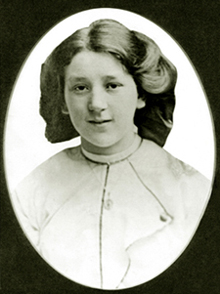 |
My paternal Grandmother, Eveline Hulme aged about 12 (photograph taken around 1908) This is actually the picture that got me started on my family research. All I ever knew about my grandmother was that she had died when my Dad was nine. We had no photographs and Dad didn't remember her very well. Then, out of the blue, my Uncle Hal sent a copy of this photo. I was deeply affected - I never thought I'd see what she looked like. It took a few months, but one day I woke up, and although I didn't have a clue how to get started, I knew I had to try to find out more about her. About two years later my Aunt Joyce sent us a later photo of Eveline and her sister Bertha, which can be seen on the Hulme Family page. |
I was almost 50 when I started researching my forebears in earnest. Usually, the first question that people would ask me upon learning of my hobby was, "Have you found anyone rich or famous in your family tree?" Although understandable, I now find this question misses the point of the real excitement involved in genealogy. What is most fascinating to me is that I can trace my poor and obscure ancestors back many generations and actually track the major events in their lives. It has been a revelation to me how much information was recorded about them and how it can be found on or through the internet.
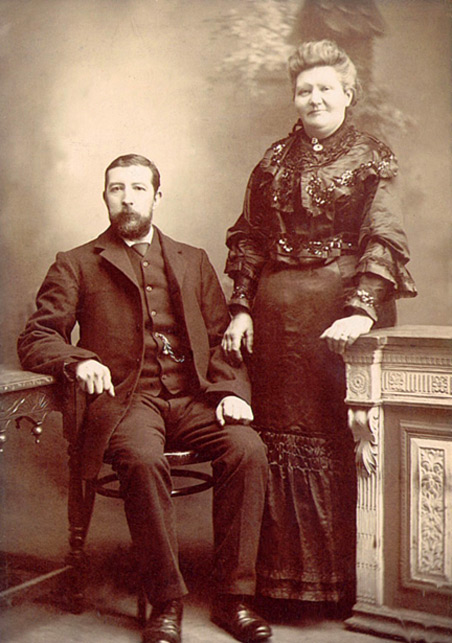
My maternal Great Grandparents, John Brooks, born John Hall in 1860 in Skipton, Yorkshire, and Isabella Brooks (nee Cartmell), born 1852 in Preston, Lancashire. This photograph bears the photographer's name on Coal Clough Lane, Burnley |
Please
click on the picture for a larger version.
Mixed with the excitement of finding information about long dead family members has been the sobering and saddening knowledge of how young many of them were when they died, and how many of their children did not survive to become adults. It has engendered a deep pride in my family; that they survived under difficult conditions and persevered to bring up their families. It also has been a fascinating education in social history, which seems so much more real to me now thanlearning it in school.
The internet also has been a great source of knowledge on the now obsolete occupations in the cotton industry in the 19th century. When I was 10, we were taken on a school trip to the last working cotton mill in Burnley, Lancashire on Plumbe Street. When my family moved to Burnley in 1959, the vista outside my parents bedroom window was a sea of pollution with black factory chimneys rising above it.
At the height of the cotton industry, the population of Burnley was more than double what it is today. Those factory chimneys are now gone, along with the back-to-back row house slums that housed the families who all worked in the mills, even the young children.
I have tried to flesh out the lives of the various family members as best I can. One of the most surprising revelations that came from this research was that my maternal great-grandfather, John Brooks had not been born a Brooks at all. He had been born John Hall, and had two older sisters and a younger brother, who were all illegitimate and they were listed as Halls in the 1871 UK Census. His mother, Ann Hall, had married a John Brooks between 1861 and 1871, and by the time of the 1881 Census, John Hall and his siblings had all changed their names to Brooks. As legal adoption did not start in England until 1947, I assumed they just decided to use the name Brooks some time between 1871 and 1881. Then I came to believe that John Brooks was the actual father. There is more on this on the Brooks pages.
Another unlooked for bonus was that my reseach put me in touch with living relatives. What a joy to hear from uncles, aunts, and cousins I had never met or even known of their existence! I really recommend genealogy as a hobby for those who enjoy stretching their minds with a little detective work and don't mind some inevitable tedium to find people who share their genes!
Unless you want to look at a particular branch of the family, the first logical page to visit would be the Williams Family.
